Cloud Migration for SMEs in the Indian Ocean Region: A Practical Guide
Most cloud migration guides are written for organizations with a dedicated infrastructure team, a fast and redundant internet connection, and cloud provider sales reps who will fly in for a workshop. That's not most businesses in the Indian Ocean region.
For a mid-sized business in the Maldives, Sri Lanka, or Mauritius, cloud migration looks different: constrained and sometimes expensive internet connectivity, a small IT team wearing multiple hats, no on-site cloud expertise, vendor support that's remote and timezone-offset, and island geography that makes hardware logistics complicated. The principles are the same as anywhere — but the practical realities are specific enough that a guide written for US enterprises isn't that useful.
This is a cloud migration guide written for businesses in the Maldives and Indian Ocean region.
Start with why, not what
The most common cloud migration mistake is treating the migration as the goal. The goal is whatever business outcome the migration is supposed to achieve — and being specific about it changes every subsequent decision.
"We want to exit our aging server room" is a different migration than "we want our application to scale during peak season without pre-provisioning." "We need business continuity if our primary island loses connectivity" is a different migration than "we want to stop paying for a data center contract." Each of these has a different right answer in terms of provider, architecture, and migration approach.
Before any technical planning, write down the actual business driver in a sentence. It will save weeks of work later.
Choosing a cloud provider in the Indian Ocean region
The three major providers (AWS, Azure, GCP) all have suitable options for Indian Ocean businesses. The choice depends on your workloads, existing tooling, and latency requirements.
| AWS | Azure | GCP | |
|---|---|---|---|
| Nearest regions | Mumbai (ap-south-1), Singapore (ap-southeast-1) | Singapore (Southeast Asia), Sydney (Australia East) | Singapore (asia-southeast1) |
| Best for | Broadest service catalog, widest regional partner network | Microsoft 365/Entra ID shops, hospitality ERP, property management systems | Data-heavy workloads, Google Workspace users |
| Regional support | Strongest South/Southeast Asia partner ecosystem | Strong for enterprise Microsoft environments | Smaller regional footprint |
AWS Singapore typically has better latency from the Maldives than Mumbai due to routing paths. Azure's Entra ID integrates tightly with on-premises Microsoft identity infrastructure, so organizations already running Active Directory get simpler identity federation out of the gate. GCP is worth a proper look if your use case is analytics-heavy or you're already on Google Workspace.

Don't let the provider choice paralyze the migration. For most SME workloads, the decision matters less than getting the architecture right on whichever provider your team can actually operate. Pick the one your people are most likely to learn on.
Connectivity realities for cloud migration in the Maldives
In mainland markets, internet connectivity is rarely a constraint for cloud architecture decisions. In island operations, it often is.
The Maldives is served by two active submarine cable systems: FALCon (connecting the Maldives to India, Sri Lanka, Oman, and the Gulf states) and a PEACE cable branch landing at Kulhudhuffushi in the north. When the PEACE cable suffered a cut in early March 2025, service was degraded for nearly three weeks before restoration on March 26. A third link is coming: Google's Dhivaru cable, named after a traditional Maldivian sailing term, will connect Addu City to Oman and Christmas Island, adding a third redundant path when complete. Know which cables your connectivity actually runs over. A single-cable failure scenario should be in your risk plan before you migrate anything critical.
If your primary internet connection is a single undersea cable link with limited failover, your cloud architecture needs to account for what happens when that link is degraded or down. This affects:
Application design. Applications that assume constant low-latency connectivity to a central cloud don't work well when connectivity is intermittent. Where possible, design for graceful degradation — local caching, offline operation modes, queue-based architectures that can hold transactions until connectivity is restored.
Backup and replication. Continuous database replication to a cloud backup requires sustained bandwidth. If your connection is constrained, consider change-data-capture replication (only transmitting the delta, not the full database) and scheduling large backup jobs during off-peak hours.
Region selection. Lower latency regions reduce the user experience impact of cloud-hosted applications. Test actual latency from your location to candidate regions before committing — cloud provider latency maps are averages, and your actual connectivity path may differ significantly.
On-premises fallback. For business-critical operations, consider whether some local infrastructure needs to remain capable of operating independently of cloud connectivity for a defined window. A resort that loses cloud connectivity during peak season can't wait 24 hours for a fix — some operational data needs to be locally accessible.
A realistic phasing model for small IT teams
Cloud migration guides often describe multi-phase programs with dedicated migration teams, project managers, and parallel run periods measured in months. For a small business with an IT team of two or three people running operations simultaneously, this isn't realistic.
A more practical model:
Phase 1: Lift and shift non-critical workloads. Identify one or two systems that are non-critical (development environments, internal file storage, secondary applications) and migrate them to cloud with minimal changes. The goal is not to achieve the optimal cloud architecture — it's to get your team hands-on with the provider, the tooling, and the migration process before touching anything important. Expect this phase to surface assumptions that need revision.
Phase 2: Establish the landing zone for production. Design the cloud environment where production workloads will live: account structure, networking (VPCs, subnets, security groups), identity configuration, and logging. Do this work carefully before migrating anything important. A poorly designed landing zone is expensive to fix after workloads are running in it.
Phase 3: Migrate critical workloads with planned maintenance windows. For each critical system: document the migration procedure, identify rollback steps, plan a maintenance window, test the migration in a non-production environment first, and execute with rollback capability available. Don't migrate systems you can't roll back if something goes wrong.
Phase 4: Decommission and optimize. Once production workloads are stable in cloud, decommission the old infrastructure. Then right-size: look at actual utilization and adjust instance sizes, purchase Reserved Instances for stable workloads, and implement cost monitoring.
Lift & shift
non-critical"] --> P2["Phase 2
Build
landing zone"] P2 --> P3["Phase 3
Migrate
critical workloads"] P3 --> P4["Phase 4
Decommission
& optimize"]
The skills gap problem
One of the biggest practical obstacles for SMEs isn't the migration itself — it's the sustained operational knowledge needed to run cloud infrastructure well after the migration. Cloud providers offer enormous capabilities, but they also have enormous surface area for misconfiguration.
Options for addressing the skills gap:
Hire cloud expertise before you need it. If your IT team has no cloud experience, adding someone who does before the migration is significantly less expensive than discovering skill gaps mid-migration.
Use managed services where possible. Choosing managed database services (RDS, Azure SQL, Cloud SQL) over self-managed VMs on cloud reduces the operational burden significantly. You don't need to know how to configure PostgreSQL replication if the managed service handles it for you. This costs more per unit but costs less in operational time and expertise.
Engage a local or regional partner for implementation. Cloud provider marketplaces and partner networks include regional firms with specific expertise. For the Indian Ocean region, this typically means Singapore or India-based firms with regional presence. They can implement the architecture and transfer knowledge to your team, rather than leaving you to figure it out from documentation.
Train the team on the specific provider you've chosen. AWS, Azure, and GCP all have free and low-cost training programs, and all three offer certification tracks that build operational knowledge systematically. Investing in a certification for your lead cloud administrator before or during the migration pays dividends in operational quality afterward.
Security baseline for your cloud environment
Cloud migration is one of the highest-risk moments for security mistakes. In 2025, 46% of SMBs had at least one critical cloud misconfiguration, and misconfigurations account for 65% of cloud-related breaches. The average breach cost from a misconfiguration is US$4.3 million. For a small business, that's an existential number.
Five controls that must be in place before you call a migration complete:
- MFA on every account — including service accounts where the provider supports it. Password-only access to a cloud console is not acceptable.
- No publicly accessible storage buckets — S3, Azure Blob, or GCS buckets that are open to the internet are the single most common misconfiguration. Audit them on day one and lock them down.
- Encryption at rest and in transit — enable it on every storage service and database. All three major providers make this a checkbox; there is no reason not to.
- Centralised logging enabled — AWS CloudTrail, Azure Monitor, or GCP Cloud Logging must be on from the start. You cannot investigate an incident without logs.
- No direct internet exposure of administrative interfaces — SSH, RDP, and database ports should not be open to 0.0.0.0/0. Use a bastion host, VPN, or the provider's session manager tools.
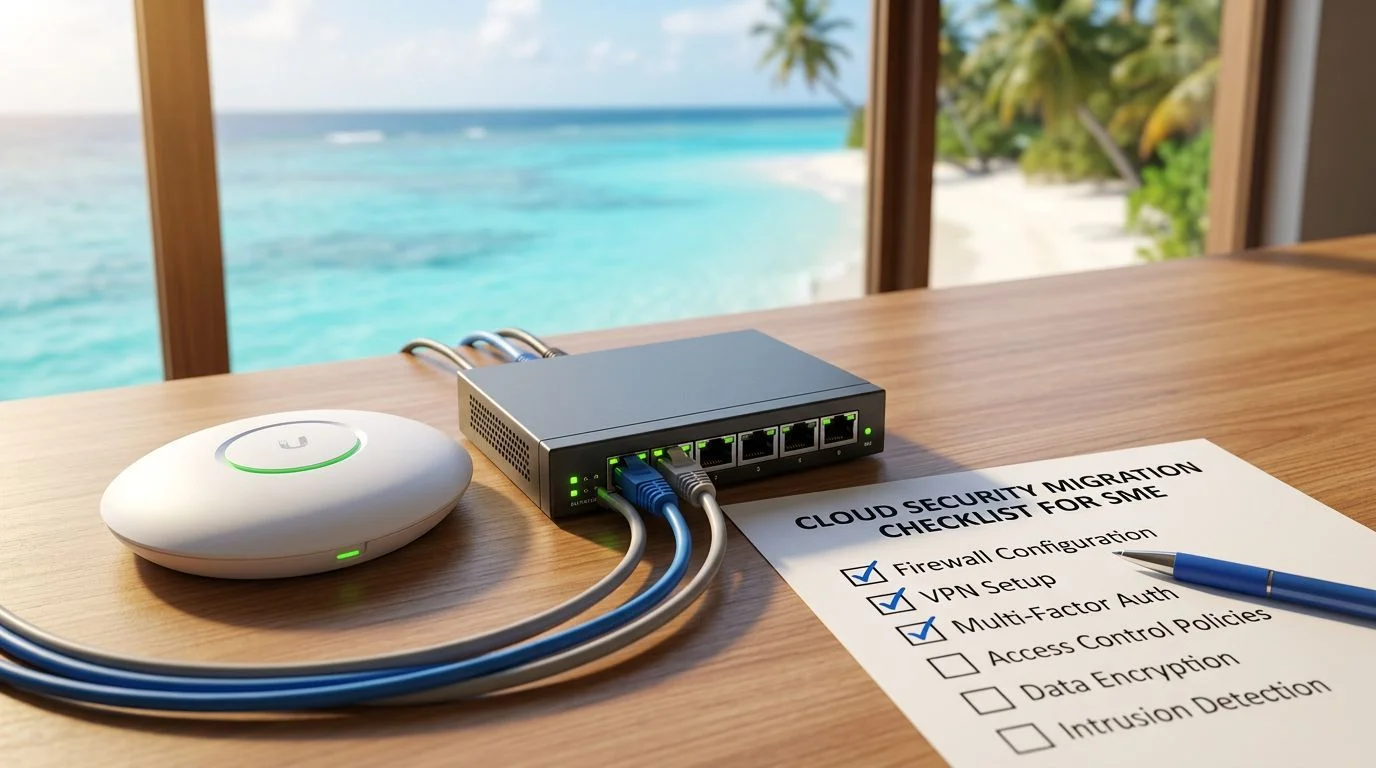
If your organization handles personal data, migration is the right moment to align with the Maldives Data Protection Act (2018) and the Privacy and Personal Data Protection Bill (2023, currently in consultation). Data in transit between your premises and cloud, and data at rest, must have appropriate protections in place. Getting this right during migration is far easier than fixing it afterward.
What a successful migration looks like
A cloud migration for an SME in the Indian Ocean region is successful when:
- Production workloads are running in cloud and the old infrastructure has been decommissioned
- The team can operate and maintain the cloud environment independently without external support for routine operations
- Cost is visible and being actively managed — you know what you're spending, why, and where
- Security baseline controls are in place: MFA, encrypted storage, logging enabled, no public exposure of administrative interfaces
- The migration achieved the original business driver (the server room is exited, the application scales during peak, the DR target is met)
That's not an ambitious list. It's realistic for an SME with limited resources. Starting here and building from it is better than planning for an architecture that never gets implemented.
References
- FALCON Submarine Cable System — SubmarineNetworks.com
- PEACE Cable — SubmarineNetworks.com
- Subsea cable projects that shaped global connectivity in 2025 — SubseaCables.net
- Introducing Dhivaru and two new connectivity hubs — Google Cloud Blog, November 2025
- 50+ Cloud Security Statistics in 2026 — SentinelOne
- 50 Cloud Misconfiguration Statistics For 2025–2026 — DataStackHub
- Maldives Data Protection Overview — DataGuidance
- Personal Data Protection Act Maldives — AmpcusCyber
We help organizations in the Maldives and the broader Indian Ocean region plan and execute cloud migrations. Our cloud migration service covers everything from strategy through execution and handover. Contact us if you want to discuss your situation.